

24 hours just to say 'hello': Voyager 1 nears historic 1 light-day mark
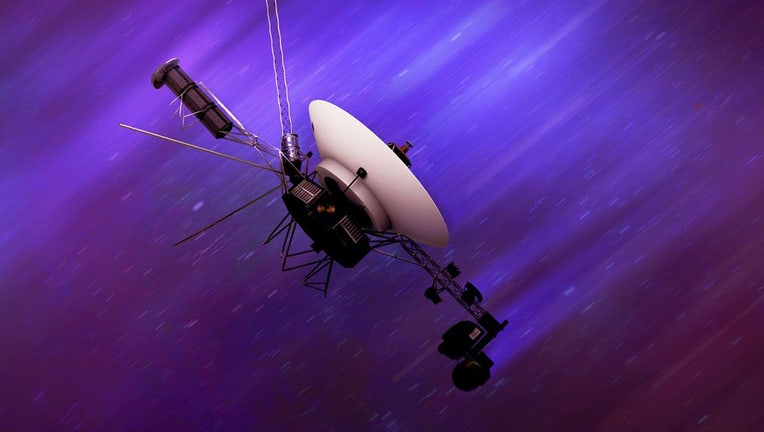
NASA's twin Voyager spacecraft, launched in 1977, are now traveling through interstellar space at around 35,000 mph (56,000 kph). This artist's concept depicts one of the probes speeding away. Image Credit: NASA/JPL-Caltech
If texting someone and not hearing back for hours sounds annoying, don’t try messaging the Voyager 1 spacecraft. Not only is the cell reception in deep space pretty bad, but getting a response in less than two days will soon be physically impossible.
Big picture view:
Voyager 1, which already has multiple firsts in its nearly 50-year-trek into interstellar space, is about to chalk up another. On Wednesday, the history-making probe will be more than a full light-day from Earth.
How far is a light-day?
Big picture view:
Speeding away from the sun at a brisk 37,844.49 miles per hour, Voyager 1 will become the first human-built object to cross that threshold as of 5:16:07 a.m. EST. At that point, the craft will be 16.094 billion miles from its home world, or more than 173 times the distance from the Earth to the sun.
After that time, when scientists want to send a command to Voyager 1, even though that message will travel at the speed of light, it will take a day to reach the probe. Any response would then take another full day to return.
RELATED: Future astronauts wanted: NASA opens recruitment for moon missions
Voyager 1 is a "national treasure"
What they're saying:
For project manager Suzanne Dodd, Voyager 1 is Earth’s ambassador to deep space and offers a "sense of wonder" to people back on our Pale Blue Dot, a nickname for our planet inspired by a photo that Voyager 1 took more than 35 years ago.
"It's a national treasure," she told The Associated Press. "Really extraordinary."
What you can do:
NASA scientists are looking forward to celebrating the occasion and are inviting people around the world to do so too. They want people to head outside after sunset on Tuesday night and shine a flashlight toward the sky and spell out in Morse code the letters V-G-R, Voyager’s call sign. For reference, V-G-R is spelled ...- --. .-. in Morse code.
The backstory:
Voyager 1 began its mission on Sept. 5, 1977, launching just over two weeks after its twin craft, Voyager 2, on a mission to explore Jupiter, Saturn, and Saturn’s moon Titan. After completing that mission, Voyager did not stop and kept going toward interstellar space. It reached that goal by passing outside the sun’s protective bubble, the heliosphere, in August 2012.
Voyager 2, meanwhile, went on the Grand Tour of Jupiter, Saturn, Uranus, and Neptune. It, too, has crossed outside the heliosphere and is more than 13.46 billion miles from Earth, traveling at a relatively slower pace of 34,142 mph. It, too, has reached interstellar space, but scientists only need just over 20 hours to get a message to it.
The Source: Information for this article was taken from NASA and The Associated Press. This story was reported from Orlando, Florida.