

Wisconsin congressional maps, judge panels must decide cases

Wisconsin congressional maps cases head to judge panels
The court battle in Wisconsin is playing out amid a national redistricting battle.
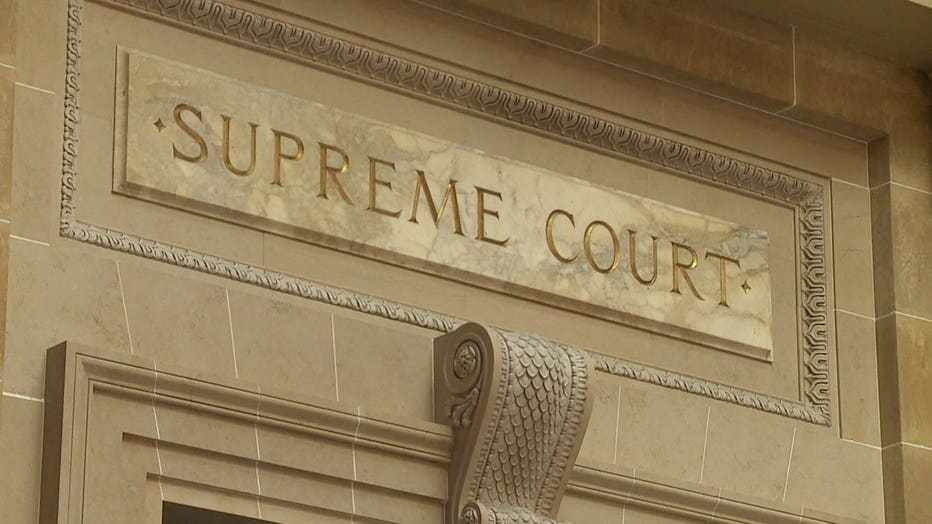
MADISON, Wis. - The Wisconsin Supreme Court on Tuesday ordered a pair of three-judge panels to hear two lawsuits that argue the battleground state’s congressional maps must be redrawn because they unconstitutionally favor Republicans.
The court's minority conservative justices blasted the creation of the three-judge panels as unimaginable political maneuvering designed to benefit Democrats.
FREE DOWNLOAD: Get breaking news alerts in the FOX LOCAL Mobile app for iOS or Android
Redistricting cases
The backstory:
Both of the pending redistricting cases in Wisconsin argue that the state’s congressional maps, first adopted in 2011, are an unconstitutional gerrymander favoring Republicans. Six of the state's eight districts are currently held by Republicans.
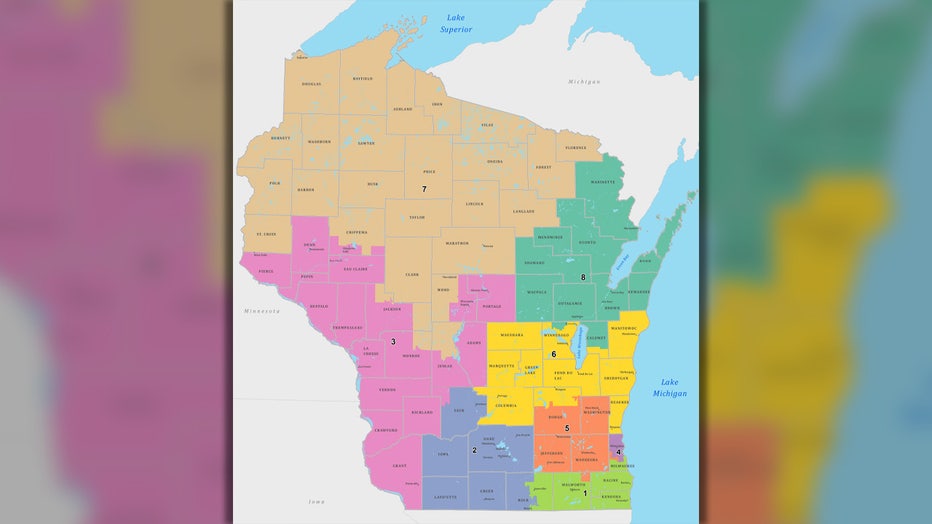
Wisconsin Congressional Districts (2025)
Law firms that brought the pending cases in Wisconsin had argued over objections from Republicans that the cases should be heard by three-judge panels as required under a 2011 law passed by the GOP-controlled Legislature and signed by then-Gov. Scott Walker, a Republican. Any decisions of those panels can be appealed to the Wisconsin Supreme Court, which is controlled 4-3 by liberal justices.
The lawsuits argue that the state's current congressional district boundary lines are unconstitutional and need to be redrawn. One case was brought by a bipartisan coalition of business leaders and the other was filed on behalf of voters by the liberal Elias Law Group.
Wisconsin’s six Republican members of Congress also argued that two of the four liberal Wisconsin Supreme Court justices who accepted millions of dollars in campaign donations from the state Democratic Party should not participate in the cases. But both Crawford and Justice Janet Protasiewicz declined to step aside.
Judge panels
What's next:
One case will be heard by judges from Dane, Portage and Marathon counties. All three of the judges endorsed Justice Susan Crawford, the liberal candidate in this year’s Wisconsin Supreme Court race, and two of them were appointed by Democratic Gov. Tony Evers.
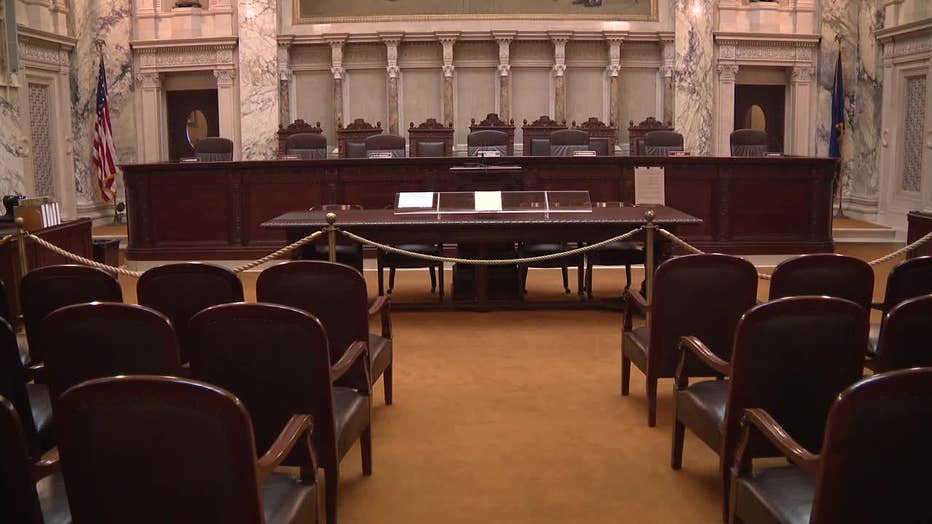
Wisconsin Supreme Court
The other case will be heard by judges from Dane, Milwaukee and Outagamie counties. Two of the judges endorsed the liberal Crawford this year and the third was appointed by Evers.
The Supreme Court did not address the underlying arguments of the lawsuit, only the procedural question of whether the cases should first be heard by three-judge panels.
The cases are pending after the Wisconsin Supreme Court earlier this year refused to hear other congressional redistricting challenges.
Justice's comment
What they're saying:
The court’s rulings to proceed with the three-judge panels were 5-2, with conservative Justice Brian Hagedorn agreeing with liberal justices that the panels were appropriate. But Hagedorn objected to the court assigning the judges to hear the cases, saying a more neutral process should have been used.
Featured
WisconsinEye warns it will shut down next month without new funding
WisconsinEye says it will shut down live coverage and its archive on Dec. 15 because of falling donations, and leaders say they need $250,000 to keep the nonprofit operating into next year.
"I am not suggesting the judicial panel will fail to do its job with integrity and impartiality," Hagedorn wrote. "But this approach is an odd choice in the face of a statute so clearly designed to deter litigants from selecting their preferred venue and judge."
The two dissenting conservative justices blasted the court's ruling creating the panels.
"Hand picking circuit court judges to perform political maneuvering is unimaginable," Justice Annette Ziegler wrote. "Yet, my colleagues persist and appear to do this, all in furtherance of delivering partisan, political advantage to the Democratic Party."
Congressional districts
Big picture view:
The court battle in Wisconsin is playing out amid a national redistricting battle as President Donald Trump is trying to preserve a slim Republican majority in the House in next year’s elections.
U.S. Capitol
Republicans hold six of the state’s eight U.S. House seats, but only two of those districts are considered competitive. In 2010, the year before Republicans redrew the congressional maps, Democrats held five seats compared with three for Republicans.
SIGN UP TODAY: Get daily headlines, breaking news emails from FOX6 News
The current congressional maps, which were based on the previous ones, were approved by the state Supreme Court when it was controlled by conservative judges. The U.S. Supreme Court in March 2022 declined to block them from taking effect.
Democrats are pushing to have the current maps redrawn in ways that would put two of the six seats currently held by Republicans into play. One they hope to flip is the western Wisconsin seat of Republican Rep. Derrick Van Orden, who won in 2022 after longtime Democratic Rep. Ron Kind retired. Van Orden won reelection in the 3rd District in 2024.
The other seat they are eyeing is southeastern Wisconsin’s 1st District, held by Republican Rep. Bryan Steil since 2019. The latest maps made that district more competitive while still favoring Republicans.
Weighing in
What they're saying:
Doug Poland, an attorney with the left-leaning group Law Forward, is representing plaintiffs in the second suit and says the goal is to create competitive elections.
"These are blow-out elections. They're not even close. They're not even contested at all, and whether they're districts that are won by Democrats or Republicans, they simply aren't competitive, and so, the voters don't have a real choice in the matter," said Doug Poland. "Ours is a nonpartisan claim. We may have Democrats who are unhappy with us for bringing this case."
UW–Madison professor emeritus Howard Schweber says conservatives have a point regarding Ziegler’s opinion, but questions whether it will ultimately matter.
"These cases are going to go to the state supreme court. Nothing final is going to come out of the decisions of these panels, and so, a certain amount of this is just show," said Schweber.
He says that’s because all appeals on panel decisions will end up at the state Supreme Court.
The fight over district maps is happening in states across the country, especially ahead of the 2026 midterms.
Any decision the panel makes can be appealed to the state supreme court. That’s part of the reason Schweber says he doesn’t expect the issue to be resolved by next November, when the balance of power in both houses of Congress is up for grabs.
The Source: The Associated Press provided this report and FOX6 spoke with officials from Law Forward and UW-Madison.